 Tap for sound
Testimonial
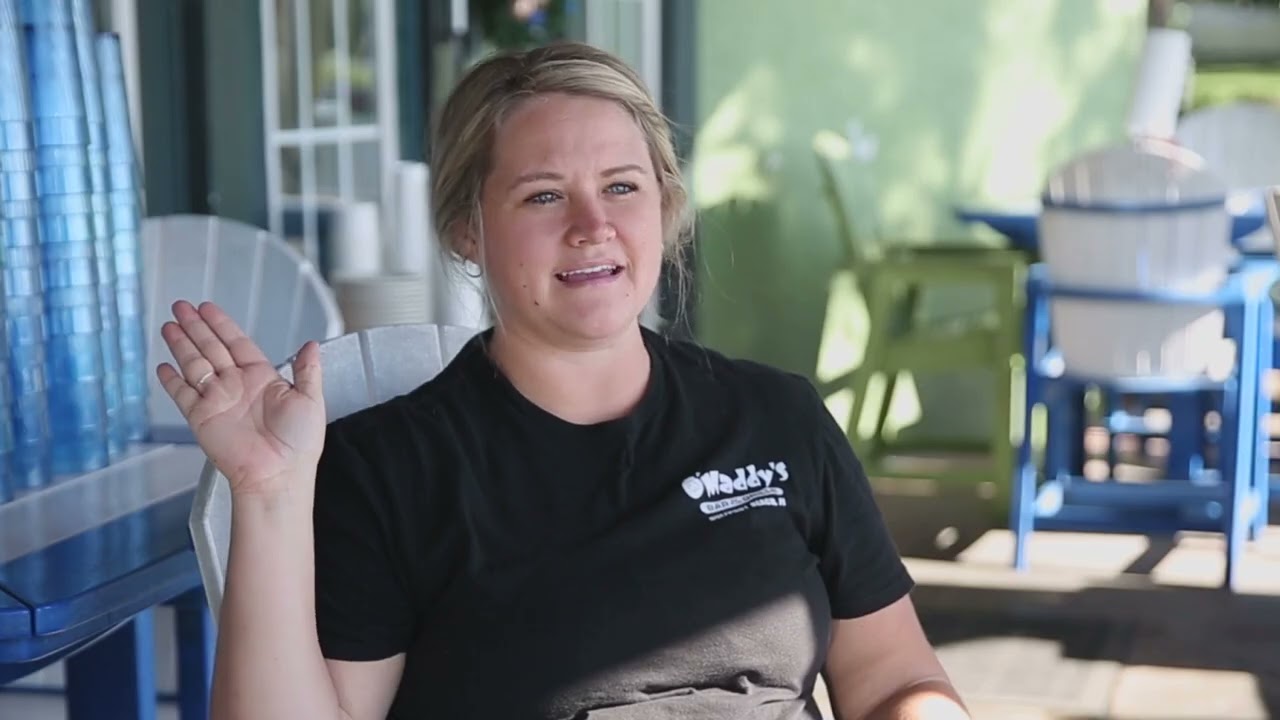
O'Maddy's Grille, Gulfport, left Toast for Lavu.
Watch the owner explain why. Two minutes, no script.
More restaurant stories →
Restaurants hand over as much as $20,000 a year in card processing and per-transaction fees. Celt Payments installs Lavu POS with a discount program built to give that money back, plus enterprise security and a rep who actually answers the phone.
 POS
Tap for sound
POS
Tap for sound
Testimonial
Watch the owner explain why. Two minutes, no script.
More restaurant stories →Most owners can quote their food cost to the decimal, yet have no idea what their real effective processing rate is. It's buried across interchange, assessments, monthly minimums, PCI fees, and quiet annual increases.
On a 6% net margin, every dollar lost to processing is roughly sixteen dollars of sales you have to make just to break even on it.
Illustrative, based on a blended effective rate across all card volume. Your actual figure depends on card mix, ticket size, and pricing model. We calculate it from your statement at no cost.
Celt Payments doesn't just drop off a terminal. We build your menu, train your staff, configure your compliance program, and stay reachable after the install.
Your menu price is your card price. Customers paying cash or debit receive a discount at the point of sale, so card acceptance stops eating your margin, and nobody pays above the posted price. In Canada, the Code of Conduct for the Payment Card Industry expressly protects a merchant's right to offer discounts by payment method. There's no separate per-transaction fee on your statement either. That is the per-item charge that sits beside your rate on most processors' statements, and quietly costs the most on small tickets. We configure the program, the point-of-sale display, and the receipt language to the rules that apply to your location.
Lavu's built-in AI reads your POS data to surface profit leaks, forecast demand, and answer operational questions in plain English. Analytics most competitors sell as a premium add-on.
Payments run on Adyen, a PCI DSS Level 1 processor. Card data is encrypted at the terminal and tokenized at rest. Your PCI paperwork shrinks dramatically.
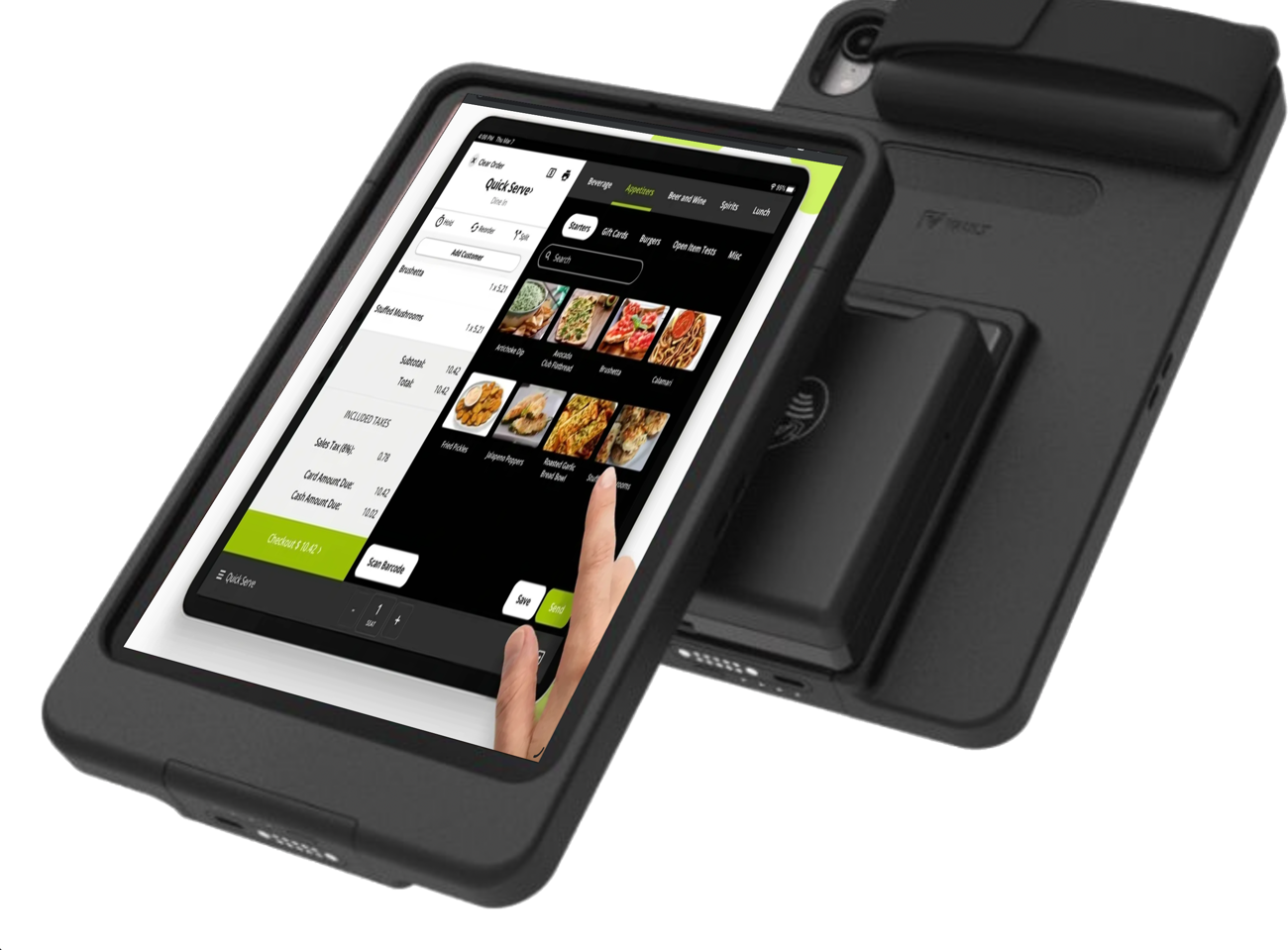
Online ordering, delivery integrations, QR ordering, and kitchen display are native, not bolted on. Floor, kitchen, and back office run on one system.
Cellular failover, offline mode, and battery backup on your network hardware, so an outage, a storm, or a flicker in power doesn't become a night of lost sales.
You get a direct line to a real person. Installation, training, and troubleshooting from someone who knows your restaurant, not a ticket number in an overseas call centre.
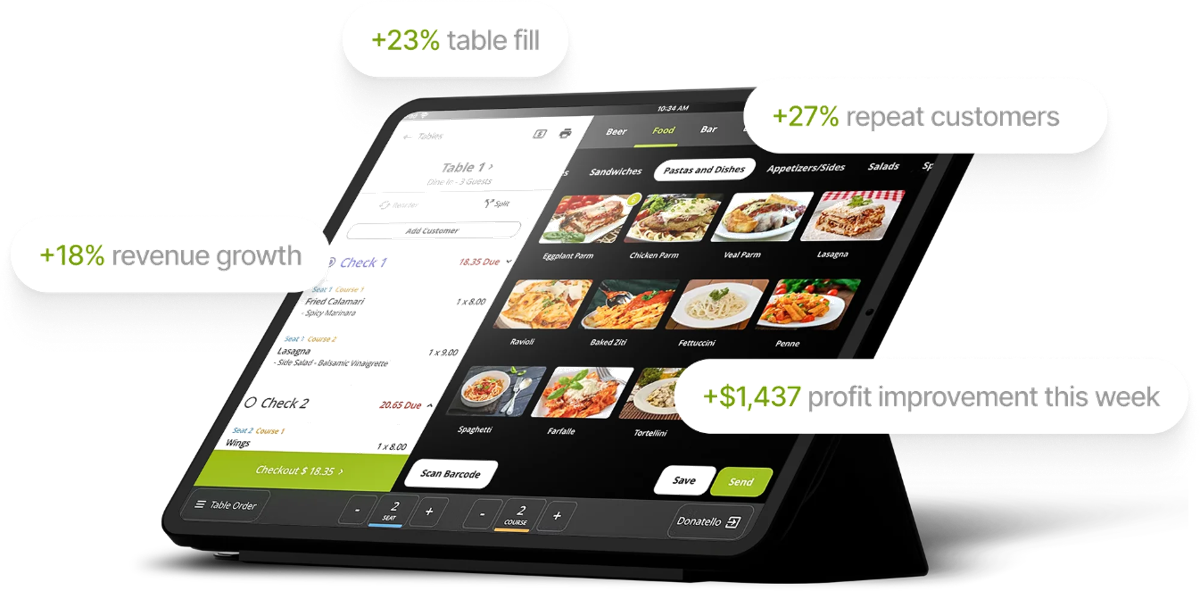
Most restaurant software is built for the manager running the floor, who is seating a party of twelve and fixing an oven, and will never read your dashboard. Marty is built for the owner. It reads across your systems every night and writes you a plain-English summary of what went wrong, what it cost, and who needs to fix it.
Setup takes about 90 minutes. Your first Morning Deposit arrives within 48 hours.
Explore Marty AI on Lavu →Overtime, unlogged comps, a location running half the productivity of its sister store. None of these fire an alert. They show up as thinner margins weeks later.
Over one three-day stretch at a four-location group, Marty surfaced roughly $8,200 at risk on day one (a cook at 90+ hours, undocumented comps, a kitchen hood failure), $10,600 more on day two, and $15,000 on day three from a two-to-one labor productivity gap between sister locations, about $33,800 in three mornings, none of it visible in any existing report.
Figures are results reported by Lavu for a specific customer group. Individual results vary and are not guaranteed.
A POS only counts the customers who already found you. Every Celt install includes the digital groundwork that brings new ones through the door, and keeps the margin on the orders you already have.
We build and optimise your Google listing: hours, photos, menu, ordering link, review prompts. It's the single highest-impact free asset a restaurant has, and most are half-finished or unclaimed.
Your branded online ordering, synced straight to your Lavu menu. One menu to maintain, orders landing directly on your POS, and the customer relationship stays yours, not a marketplace's.
Through the MenuDrive–DoorDash partnership, orders from your own site are fulfilled by Dashers for a flat per-delivery fee, commission-free to you, instead of marketplace commissions that can reach 30% of the ticket.
On a $60 order, that's roughly $18 to the marketplace versus about $6 in delivery cost. Exact flat fee varies by market and distance and is confirmed per agreement.
See MenuDrive online ordering →Menu and location data structured so search engines, and AI assistants people now ask for recommendations, can actually read it. The goal is simple: when someone nearby searches for what you serve, you come up.
Plenty of operators aren't ready to move a whole floor onto a new POS, and that's a fair position to hold. The Adyen S1F2 runs the cash discount program on its own. Staff key the amount in, the terminal handles the rest, and your existing till stays exactly where it is.
One posted price, which is the card price. When the terminal is handed over, the guest picks how they're paying. Cash and debit both take the discount; credit pays the posted price. Nobody is charged above what's on the menu, and the discount is printed on the receipt.
In Canada the program is structured as a discount, never a surcharge, and Interac debit receives the same discount as cash. We set the discount rate, the terminal display and the receipt wording to the rules that apply in your province or state.
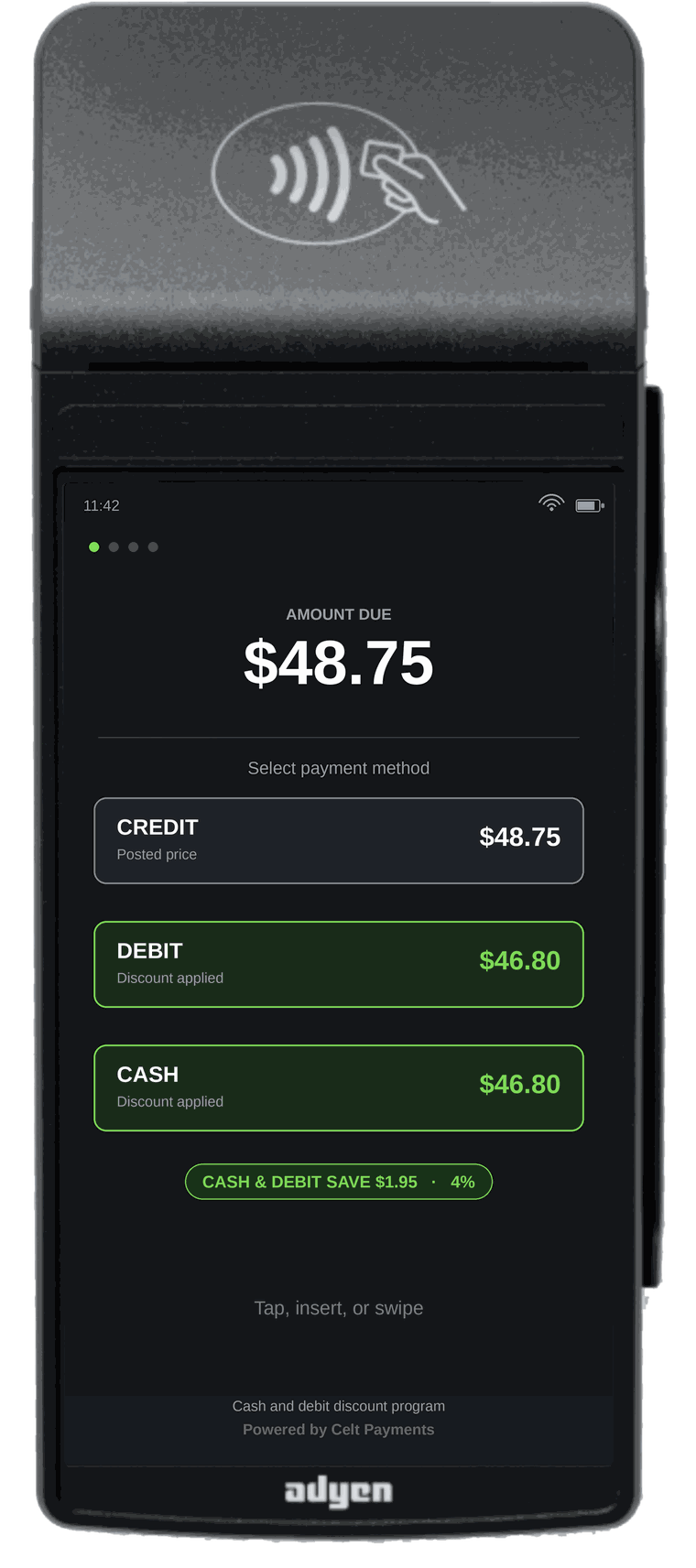
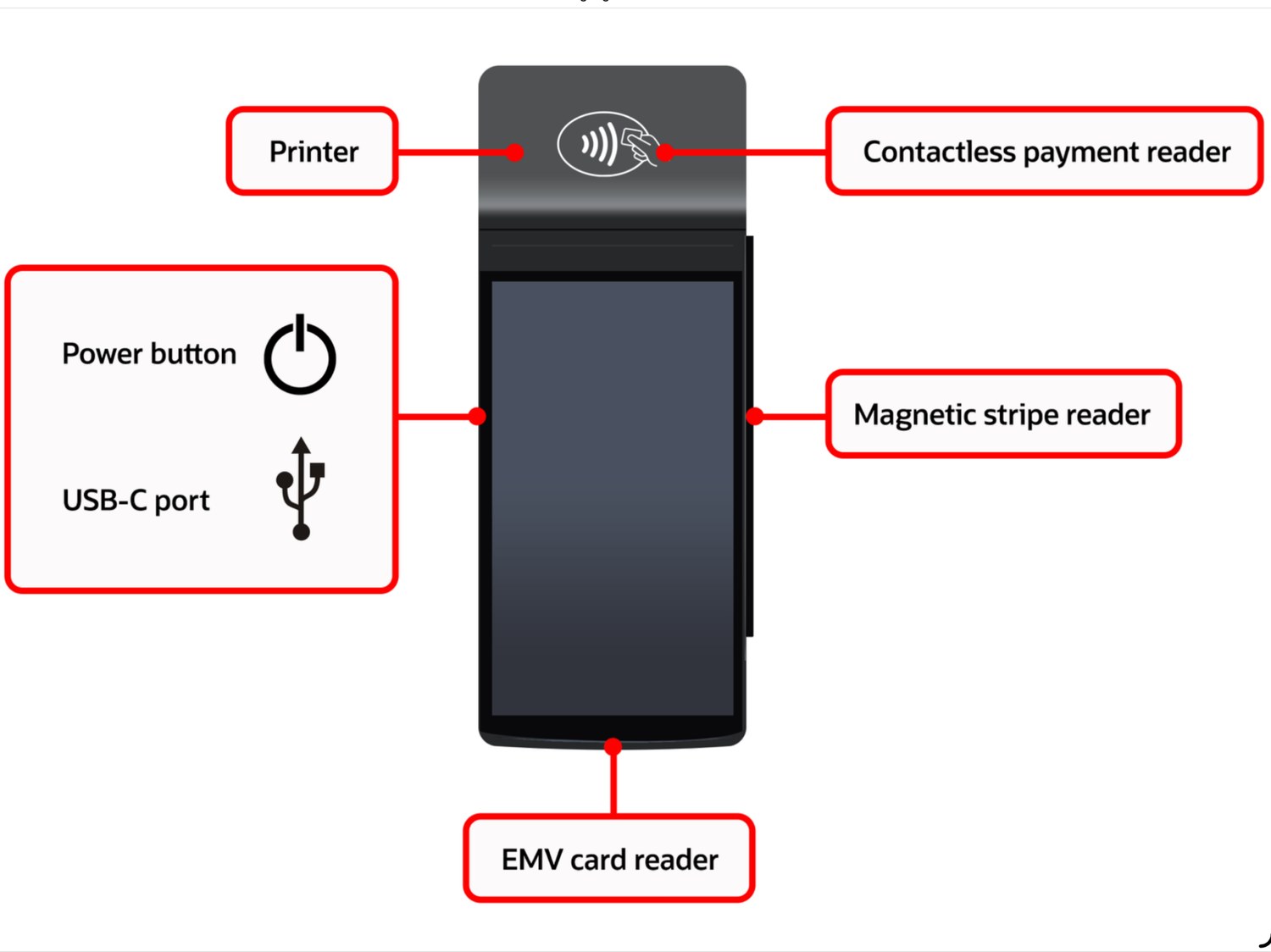
Tap, chip, swipe and phone wallets, with a printer built in so the receipt is handed over at the table. Charges over USB-C. No countertop base, no second terminal to reconcile.
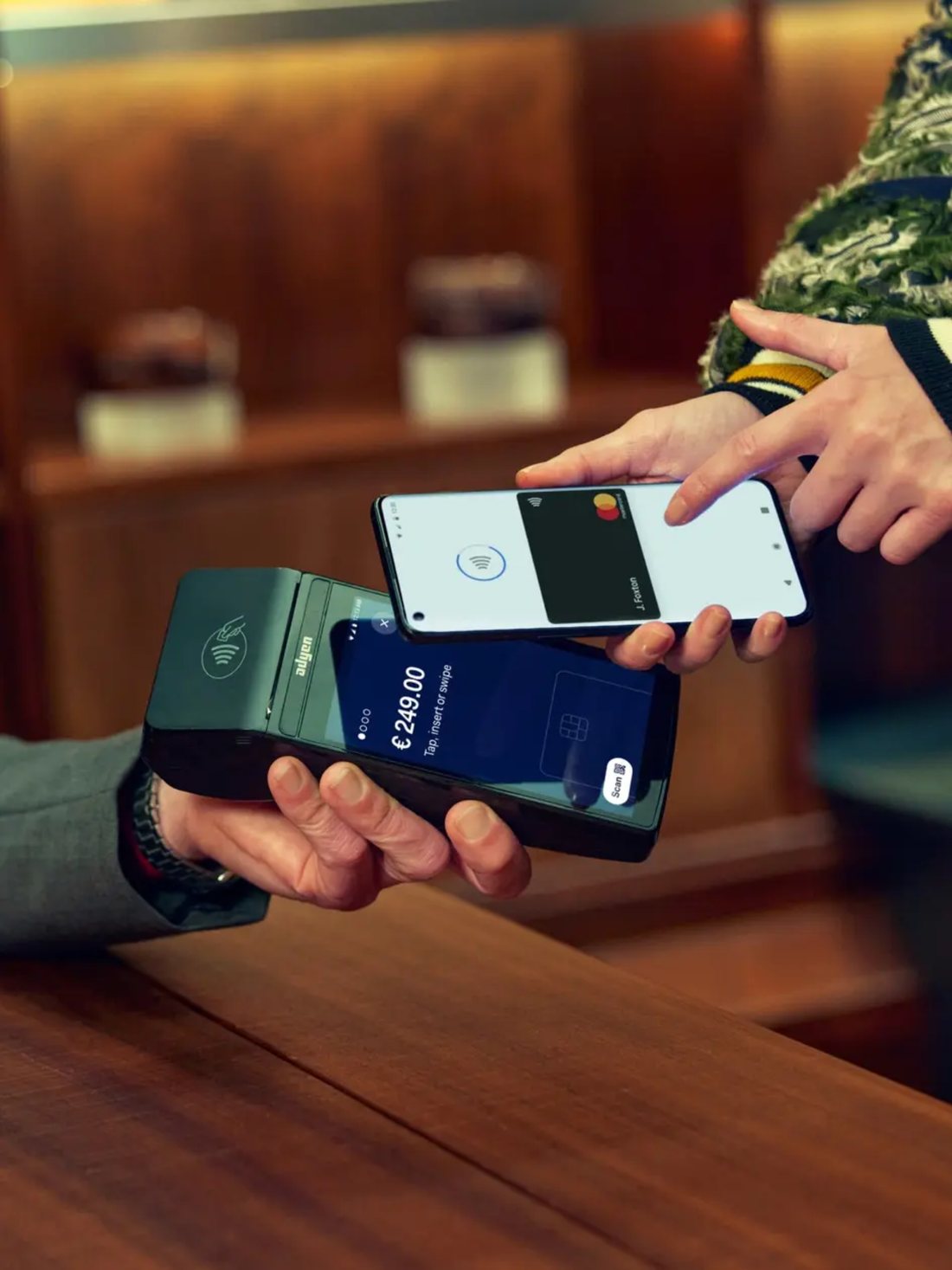
The card never leaves the guest's hand, which is the part regulars notice first. Tables turn faster because nobody walks to the counter twice, and tips are prompted on screen rather than written in afterwards.
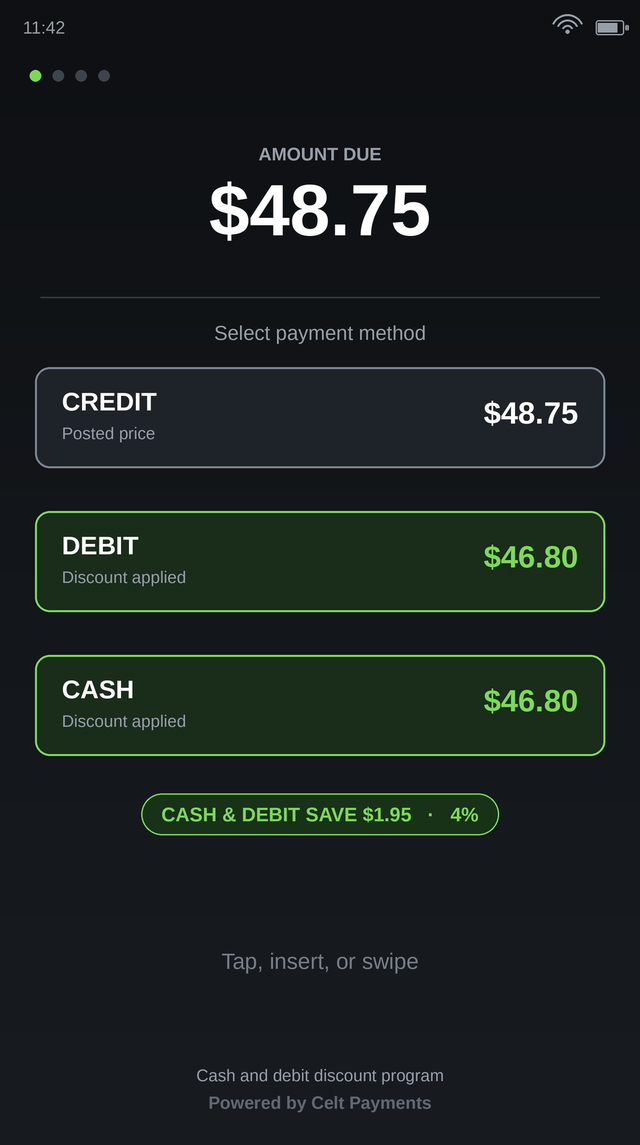
No middleware and no menu build. A server enters the amount and hands the terminal over. If you move to Lavu later the same hardware carries across, so this isn't a purchase you throw away.
The point of a terminal that runs on its own is that you can check the numbers without committing the floor. Sixty days, one station, measured against your own statements.
Your last three processing statements, worked out to a real effective rate. Not an estimate and not a projection.
Sixty days on the S1F2. Your POS, your menu and your reporting stay exactly as they are.
The difference against your baseline, in writing, from the transactions you actually ran.
If the savings aren’t there, you’ve lost a pilot. If they are, the next step is yours to choose.
Lavu publishes its customer stories and its support reviews in the open. We'd rather you watched and read them at the source than took our word for it.
Four short videos published by Lavu. The first two are the ones we'd send a Florida or Ontario operator first.
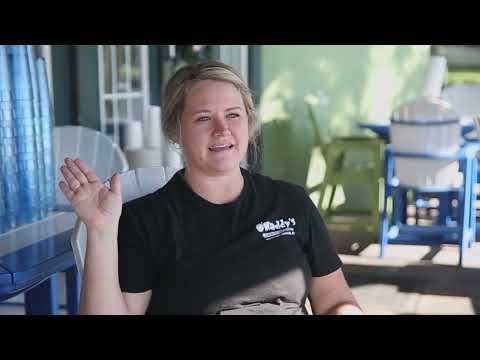
O'Maddy's Grille, Gulfport
Switched from Toast. A high-volume Florida waterfront restaurant on why.

Willow Creek Winery
Serves well over 2,000 guests a day on Lavu.
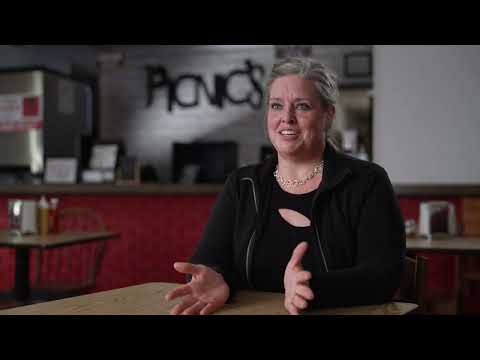
Picnic's Pizza
A pizzeria on what the discount program saves them each month.

As seen on television
Lavu featured on a televised restaurant turnaround.
Lavu publishes its customer support reviews as they come in, dated, with the name of the agent who took the call. Nobody curates them into a highlight reel. It's the most honest thing a POS company can show you, because support is where every platform gets found out.
Read them and note two things: how often the review mentions a printer or a kitchen ticket, and how often it mentions a real person answering the phone.
Read Lavu's Wall of LoveThese are copied verbatim from Lavu's page, with the reviewer's first name and the date they left it. They are Lavu's customers writing about Lavu's support, not ours. Read the rest at the source.
“Easy to call, talked to a real person after 1 ring, issue handled quickly”
“The assistant enabled my cash discount program quickly and easily.”
“Austin fixed our kitchen printer issue quickly, efficiently, and professionally”
“Fast and easy. Resolved my issue in under 2 mins.”
“It only took two minutes to straighten out the problem”
“Issue was resolved. Great highly professional support. Thank you”
Reviews are published in English on Lavu's site.
Three tiers, quoted per location. Every tier includes the cash and debit discount program, Adyen processing and 24/7 support. Ask us and we'll tell you which one you actually need, which is usually not the top one.
Starter
For a single location running the floor
Quoted per location
Ask which tier fitsGrowth
For operators who take orders online
Quoted per location
Ask which tier fitsOptimize
For multi-location groups and high volume
Quoted per location
Ask which tier fitsLavu connects to the tools most restaurants already use. Grouped by what they do; the full list with descriptions is on Lavu's site.
Full integrations list on lavu.com →
Customer videos and reviews are published by Lavu, Inc. and are shown here as links to the original. Plan contents reflect Lavu's product set as resold by Celt Payments; pricing is quoted per location after a statement review and is not set by Lavu. Integration availability can vary by region and some third-party integrations connect through an integrator.
Restaurant POS systems are a prime target. The strongest defence isn't a better firewall. It's making sure there's no readable card data on your network to steal in the first place.
Tap, chip, or swipe on the handheld right at the guest's table.
Encrypted inside the device before it leaves. PCI-validated P2PE available.
Only Adyen's PCI DSS Level 1 environment can decrypt. Stored cards become tokens.
One platform from terminal to settlement, one accountable partner.
Every major platform clears the PCI baseline. The differences show up in what a switch costs you, what you're locked into, and who picks up the phone.
Swipe the table sideways to see every provider →| What owners care about | Celt + Lavu | Shift4 Dine | Toast | Square | Clover | Moneris | Touch‑Bistro | Silver‑ware |
|---|---|---|---|---|---|---|---|---|
| Program to offset card processing cost | ● | ● | ◐ | ◐ | ◐ | ○ | ◐ | ◐ |
| No separate per‑transaction fee on your statement | ● | ○ | ○ | ○ | ○ | ○ | ○ | ◐ |
| Reduced exposure to mid‑contract rate increases | ● | ○ | ○ | ◐ | ○ | ○ | ◐ | ◐ |
| Freedom to choose your own processor | ● | ○ | ○ | ○ | ◐ | ○ | ● | ● |
| Freedom from long contract lock-in | ◐ | ○ | ○ | ● | ○ | ○ | ◐ | ◐ |
| Low upfront hardware cost | ● | ● | ○ | ● | ○ | ◐ | ◐ | ○ |
| Staff trained in a single shift | ● | ◐ | ◐ | ● | ◐ | ◐ | ● | ● |
| A named local rep who answers | ● | ◐ | ◐ | ○ | ◐ | ◐ | ◐ | ○ |
| Native AI analytics included | ● | ○ | ◐ | ○ | ○ | ○ | ○ | ○ |
| Lightest PCI compliance burden | ● | ◐ | ◐ | ◐ | ◐ | ◐ | ◐ | ◐ |
● Solves it well · ◐ Partial / varies by plan · ○ Works against the owner. Competitor positioning reflects publicly available information as of August 2026 and general market terms; plans and agreements vary, so confirm against your own contract. Fee changes we cite are drawn from published merchant notices and are dated on our Fee Watch page.
Download the full comparison PDF · 2 pagesThrough a discount program built into the point of sale. Your menu price is your card price, and customers paying cash or debit receive a discount when they pay, so the cost of card acceptance is carried at the point of sale rather than absorbed by your margin. Nobody pays more than the posted price. Lavu supports this natively, and we configure the program, the point-of-sale display, and the receipt language to the rules that apply to your location.
Two things, and most owners only count the first.
The rate. In the United States, most restaurants pay a blended discount rate between roughly 2.6% and 2.9% of card volume. In Canada, credit typically runs near 2.4%, while Interac debit is charged differently, which is why the two need to be worked out separately.
The per-transaction fee. Usually $0.10 to $0.25 on every sale, charged regardless of ticket size. A restaurant running 2,000 transactions a month pays $2,400 to $6,000 a year on this line alone. It hurts most on small tickets: a quarter on a $6 coffee is over 4% on its own.
Put together, a restaurant at $50,000 a month in card volume and 2,000 transactions is typically looking at roughly $15,000 a year in Canada and around $20,000 in the United States. Work it out separately for credit, debit, and per-transaction fees. Blending them hides where the money actually goes.
The right is protected federally. The Code of Conduct for the Payment Card Industry in Canada requires that payment card network rules allow merchants to provide discounts for different methods of payment (cash, debit card, and credit card) and to offer differential discounts among networks, provided any discount is clearly marked at the point of sale.
This is different from a surcharge, which adds a fee on top of a posted price and carries its own separate rules, including a cap on credit, a prohibition on merchants surcharging Interac Debit, and a prohibition in Quebec. Our program is structured as a discount, not a surcharge: one posted price, reduced for customers paying cash or debit. Nobody pays more than the price on the menu.
Requirements vary by province and by state, so we configure every program, including the point-of-sale display and receipt language, to the rules that apply to your location. We'd always encourage you to confirm your specific setup with your acquirer and your own advisor.
Lavu's payment processing runs on Adyen, a PCI DSS Level 1 certified processor. Card data is encrypted at the payment terminal and tokenized at rest, so raw card numbers never reach your POS, your Wi-Fi, or your back office. That also reduces your PCI compliance paperwork substantially compared with handling raw card data.
Marty is Lavu's built-in artificial intelligence for restaurant operations. It reads your POS data to surface profit leaks, forecast demand, and answer operational questions in plain language. It is effectively an always-on analyst, included rather than sold as a premium add-on.
With the right setup, you keep serving. A cellular failover modem keeps the system fully online through an internet outage. Lavu also supports an offline mode that stores transactions and forwards them once you reconnect, though offline transactions aren't authorized until reconnection, so there's some risk on declines. Power outages need battery backup on your network hardware. We configure this resilience kit at installation.
It's the number one hesitation we hear, and a fair one. We handle the menu build and data migration, and schedule the cutover around your slow period, never mid-rush, and never mid-season if we can avoid it. Staff training is typically a single shift because the interface is iPad-simple.
You won't see a separate per-transaction fee on your statement. The cost is carried by the discount program rather than billed to you as its own line item.
That matters more than most owners expect. On a conventional plan the per-item fee is charged on every single sale regardless of size, so it lands hardest on coffees, sides, and small takeout orders. A quarter on a $6 coffee is over 4% of the ticket on its own, before the discount rate is even applied. At 2,000 transactions a month and $0.10 to $0.25 a transaction, that's $2,400 to $6,000 a year sitting in a line most people never read.
No. In Canada, Interac debit customers receive the same discount as cash customers. We don't surcharge debit. Merchants aren't permitted to, and we wouldn't structure a program that way.
The menu price, and then a discount shown as a reduction if they pay cash or debit. Sales tax is calculated on the discounted amount, because a genuine discount reduces the amount being taxed. A guest paying by credit card sees the menu price with nothing added. Signage at the point of sale states the program before anyone orders, which the Code of Conduct requires in Canada.
In most merchant agreements, yes. Processors can typically change rates during the term on written notice, and continuing to process is treated as acceptance. Several major providers raised merchant rates during the first half of 2026, and we track the documented ones on our Fee Watch page. The harder problem is that when your POS software and your processing are the same contract, you can't shop the rate without replacing the whole system. A discount program reduces your exposure to processing rate changes, though it doesn't cover subscription, hardware, or service fees, which remain separate line items.
Nothing. Bring us one recent processing statement and we'll show you your true effective rate and exactly what a switch would save. No obligation, no pressure. If you're already in a good deal, we'll tell you that too.
One recent processing statement is all it takes. We'll show you your real effective rate and what you'd keep. Free, and no obligation.